
An orange with a candle

It’s the most wonderful time of the year, as the saying goes; Advent. And singer Andy Williams wasn’t wrong. One of the most beautiful moments in the run-up to Christmas is a tradition I discovered in England, specifically during my son Lieven’s primary school days. On a Wednesday, the day after the celebration of the Immaculate Conception of Mary, the entire school went to church for Christingle.

Each child received a Christingle, an orange candle decorated with a red ribbon and sweets or dried fruit. It symbolises the birth of Christ, the Light of the World. The orange represents the world, round and complete. The red ribbon is wrapped around the center of the orange and symbolises the blood of Jesus, shed on the cross, and God’s love for the world.
A candle inserted into the orange is lit during the service. This represents Jesus as the “Light of the World,” bringing hope and shining in the darkness. Four cocktail sticks, strung with dried fruit or candies, represent the four seasons and the four cardinal points. Finally, the dried fruit/sweets symbolise the fruits of the earth and the abundance of God’s creation, nourished by sunshine and rain.
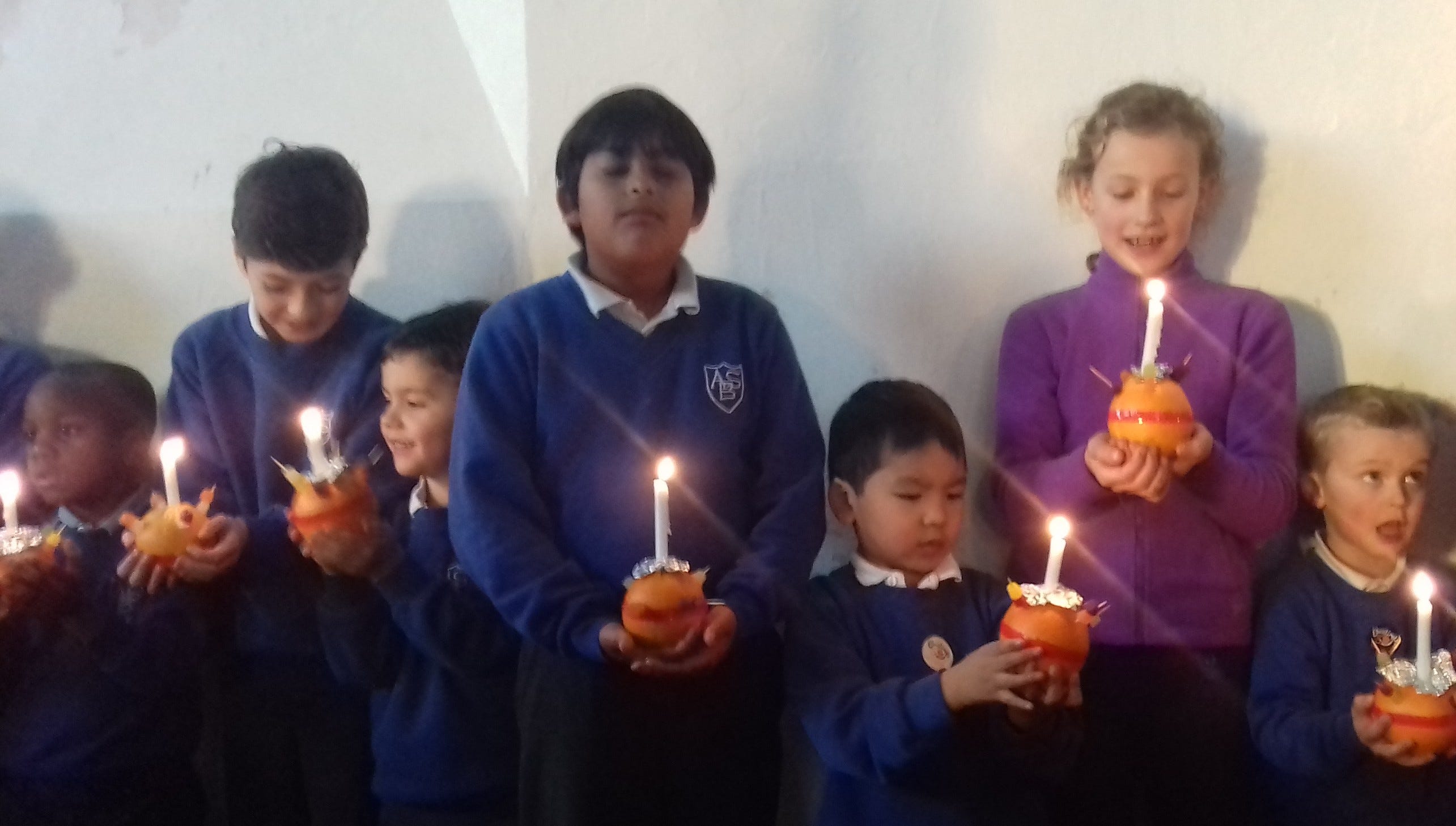
It’s not originally an English tradition, but an import. The custom originated in the mid-eighteenth century in a Moravian church in Marienborn, Germany, when Bishop Johannes de Watteville used a simple candle with a red ribbon to explain the meaning of Christmas to children. The custom spread among Moravian missionaries. In 1968, the tradition arrived in Britain, thanks to The Children’s Society.
The idea behind the service was to raise money for vulnerable children. The first service was held at Lincoln Cathedral, where attendance was larger than expected. Now it’s celebrated by millions of children and their parents. A few years ago, the Killjoys at Chelmsford Cathedral decided to replace the burning candles with battery lights for safety reasons, but this led to much criticism.

After all, for children, playing with fire is the most exciting part of this tradition.
 | A guest post by
|