
By Everest
Confusion in Hove

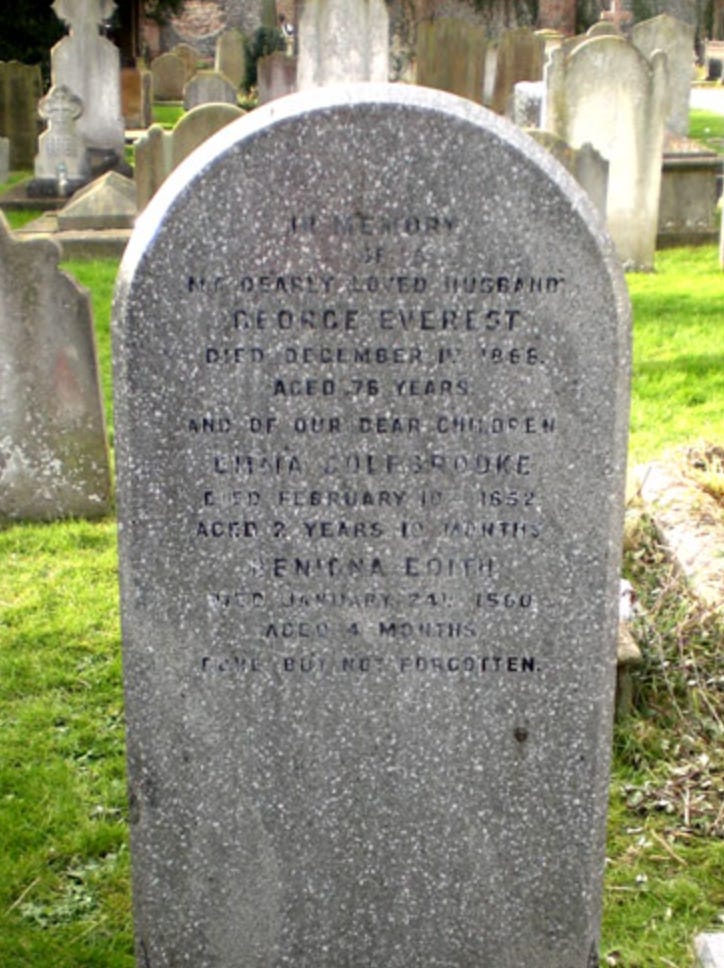
You’ll always discover something new if (like me) you can’t resist visiting every cemetery you happen to pass. A few days ago, for example, I was in Hove and came across the grave of George Everest. As I read at the entrance to St. Andrew’s Church, he is the man after whom Mount Everest is named.
For many years, Everest headed the British delegation that attempted to map out India. Thanks to his work, it became clear by the mid-nineteenth century that ‘Peak B’ and later ‘Peak XV’ were the highest mountains in the world. Mount Everest, as it was not yet called, had many other names. In Tibet, the mountain is still called Chomolungma (Mother Goddess of the World), and in Nepal it is Sagarmatha (Goddess of the Sky). And there were about ten other names.
In 1854, Andrew Waugh, Everest’s successor in India, wanted to end the confusion, and proposed naming the mountain after his predecessor. Initially, Everest declined the honour, believing his name was too difficult to pronounce by the locals and difficult to write in Hindi.
Another of Everest’s objections was that he had never actually seen the mountain itself. While he had conducted cartographic research in the Himalayas, he had never seen Everest’s summit, let alone climbed it.
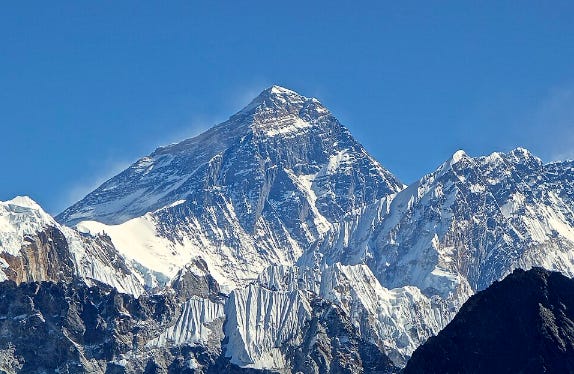
Incidentally, Everest himself wasn’t the only one to object - so did a large portion of the indigenous population. Waugh first proposed the idea in 1854. It wasn’t until 1865 that the debate was settled and the name Everest was chosen.
Everest eventually agreed to the name, but he still wasn’t satisfied. To his chagrin, the mountain, which effectively earned him worldwide fame, wasn’t pronounced the same as his own surname. It sounded more like EEvrst. Fortunately, he didn’t have long to live with this annoyance, as he died at the end of 1866.
The location of his grave is also a bit involved. Everest, who died in London, had no connection to Hove. Apparently, his father-in-law lived nearby. This would explain why two of Everest’s children, who died young, are said to be buried in Hove. However, no one really knows the whole story. Nevertheless, Hove is proud of its world-famous outsider.