
Cushions
My Top 12: Number 9

English churches are, naturally, fantastic. While there are only five Romanesque churches in the Netherlands (outside of Friesland), they’re everywhere in England. Every time I enter an English church and bump my head, I wonder if there’s a church in this country that isn’t medieval. Plus, after this good bump, nearly every one of them is a marvel.
The most marvellous thing about English churches, however, has nothing to do with the architecture. It’s the hand-made cushions on the kneelers. Some have a religious theme—a cross or a dove of peace— others depict aspects of English village life, such as a tractor, or episodes from English history, like Spitfire bombers or even power stations, and still others bear the initials of villagers who died during World War II.
They are all the result of considerable dedication. The cushions are made using needlepoint. I’ve been told that each cushion takes one hundred and ten hours of painstaking work. In Guildford Cathedral, where there are over fifteen hundred different cushions, one woman is said to have been responsible for fifty of them. That’s almost three years’ worth of official work weeks, if she didn’t take too much vacation.
The first cushions apparently date back to the sixteenth century, but they became widespread in the late 1950s and early 1960s. It’s interesting to note that some parishes had strict rules restricting the designs, while more freedom was given in other churches.
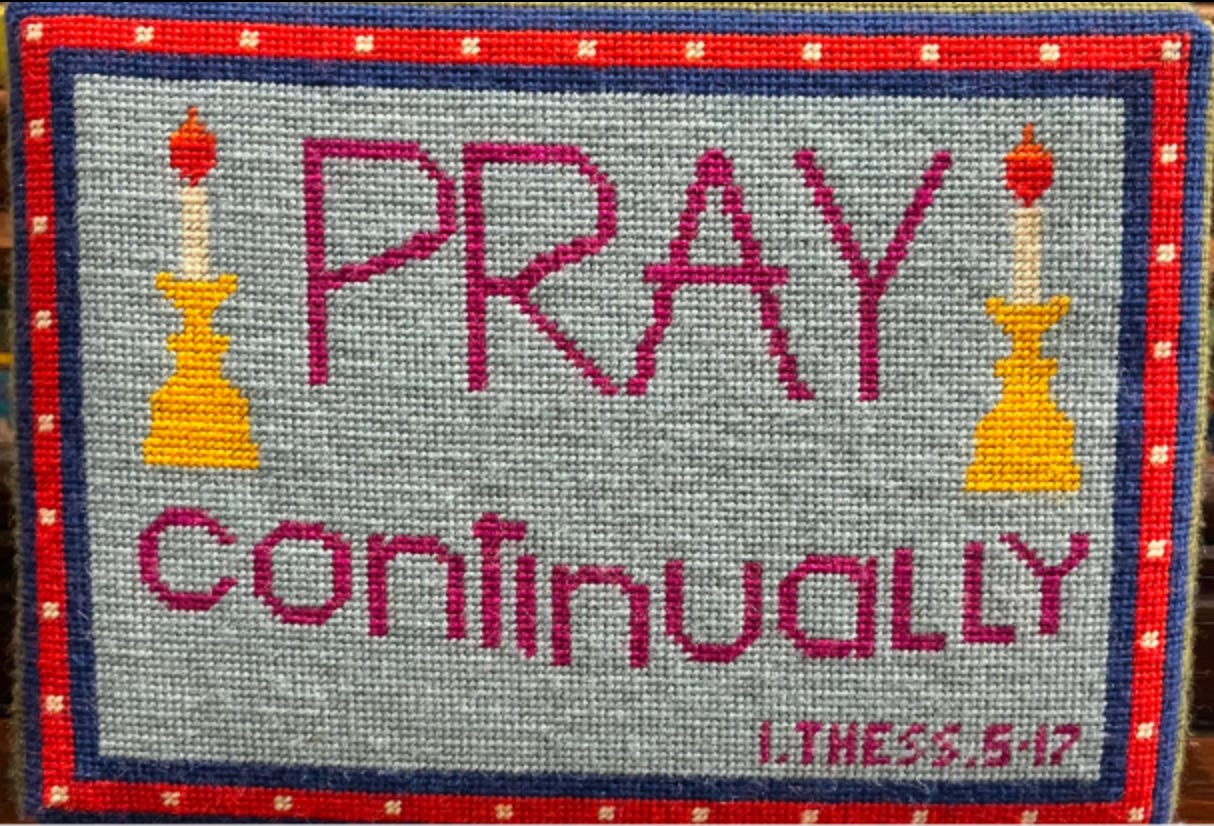
The cushions are used when kneeling is required during a service. The English term for the cushions is therefore “kneelers.” Kneeling was a ritual in the Catholic mass that the high Anglican church effortlessly adopted.
But even with this, tradition is under pressure. In order to facilitate kneeling, a low railing is attached to the back of the pew, in front of the kneel-er. The cushions are placed on the rail, making kneeling considerably more comfortable.
However, as I read in the “Clerical Whispers” blog, many churches are now removing the pews and replacing them with chairs. These can be removed if necessary, making the church “multifunctional.” I write this with a somewhat sour expression on my face.
With the introduction of chairs, kneeling and therefore cushions are apparently no longer needed. This seems like a terrible impoverishment to me. Not only are they charming, but there’s also something lovely about knowing that your grandmother or great-grandmother (almost all the cushions are made by women) made a particular cushion in your village church.
And there’s another thing. In all the years I’ve visited English churches and admired the cushions, I don’t think I’ve ever seen one with a hole in it. Only the images—for example, an old-fashioned tractor—show that they’re over half a century old. Maybe they are in such good shape because they’re rarely used. Who knows?
You never pointed out these cushions to me! Remember for my next visit!