
Departed
Brookwood Cemetery

I remember exactly when I fell in love with England. It wasn’t a head-over-heels thing, which isn’t really my style. It wasn’t even during the period I spent a significant amount of time in Cambridge. I guess I was too busy falling in love with Julie back then. I’m not the kind of person who can handle more than one crush at a time.
It happened gradually during the trip Julie and I took to England to celebrate her fortieth birthday. We planned a route through southern England—Canterbury, Chichester, Winchester, Oxford, Chartwell—in search of artworks, mainly gravestones, by the sculptor and typeface designer Eric Gill.
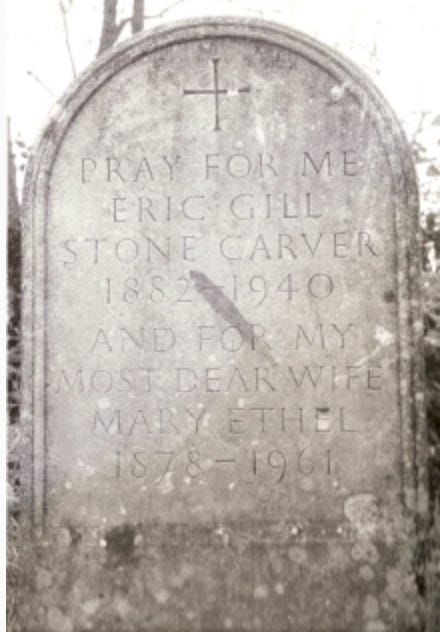
It was a thoroughly enjoyable trip, taking us to Ditchling, Wivelsfield, and Hassocks, to name just a few places we now live near. It was a long journey along picturesque back roads to local cemeteries, where the grass was mown every six months and where gravestones were crooked and uneven, yet so charming. That’s when I fell in love with the country.
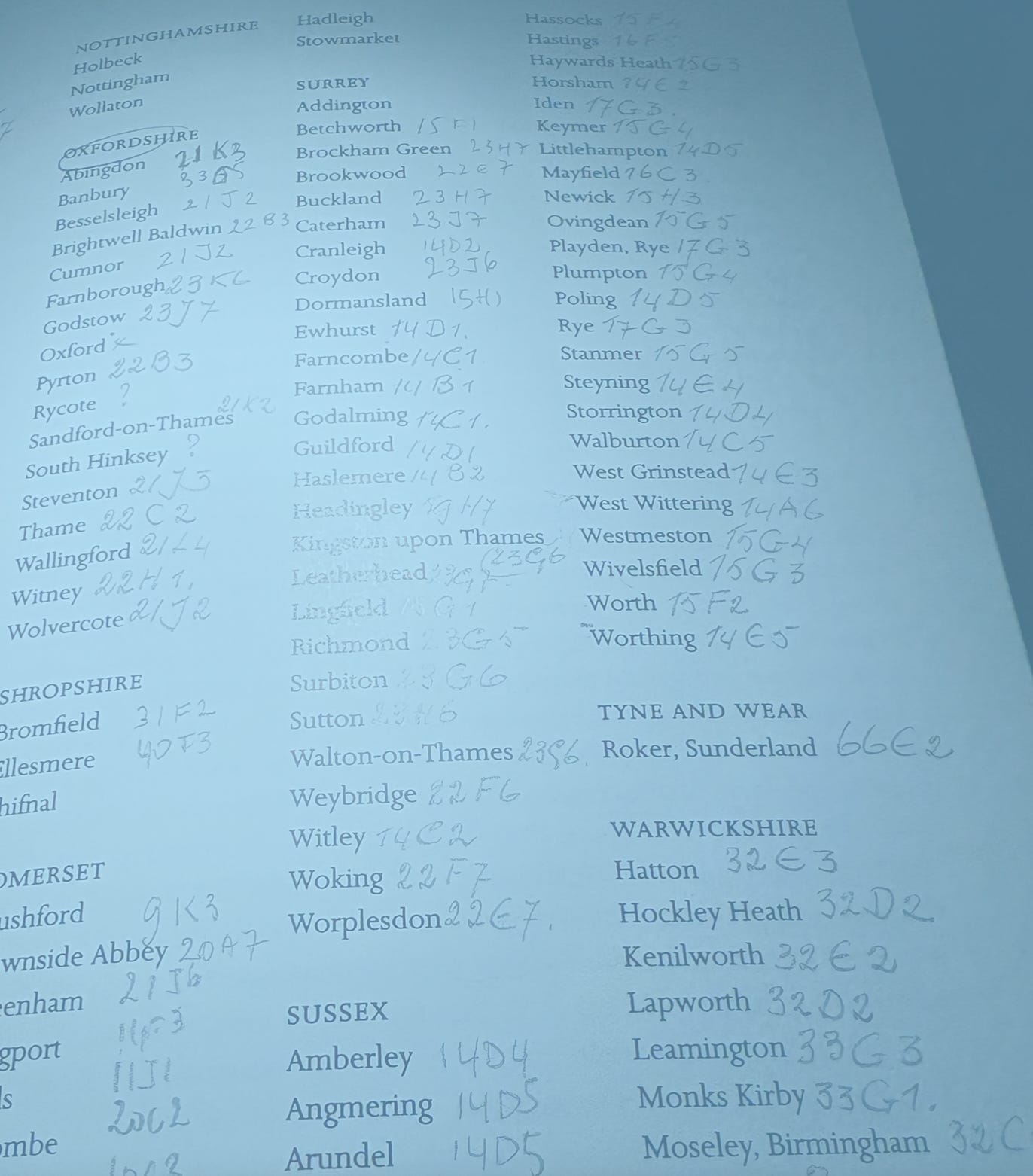
We had a book that was a catalogue of Gill’s gravestones and war memorials. I spent an evening with my uncle Fried (looking at it now, I recognise his handwriting) looking up all the place names from the book’s index and circling them on a road map. With that as our guide, we zigzagged through southern England.
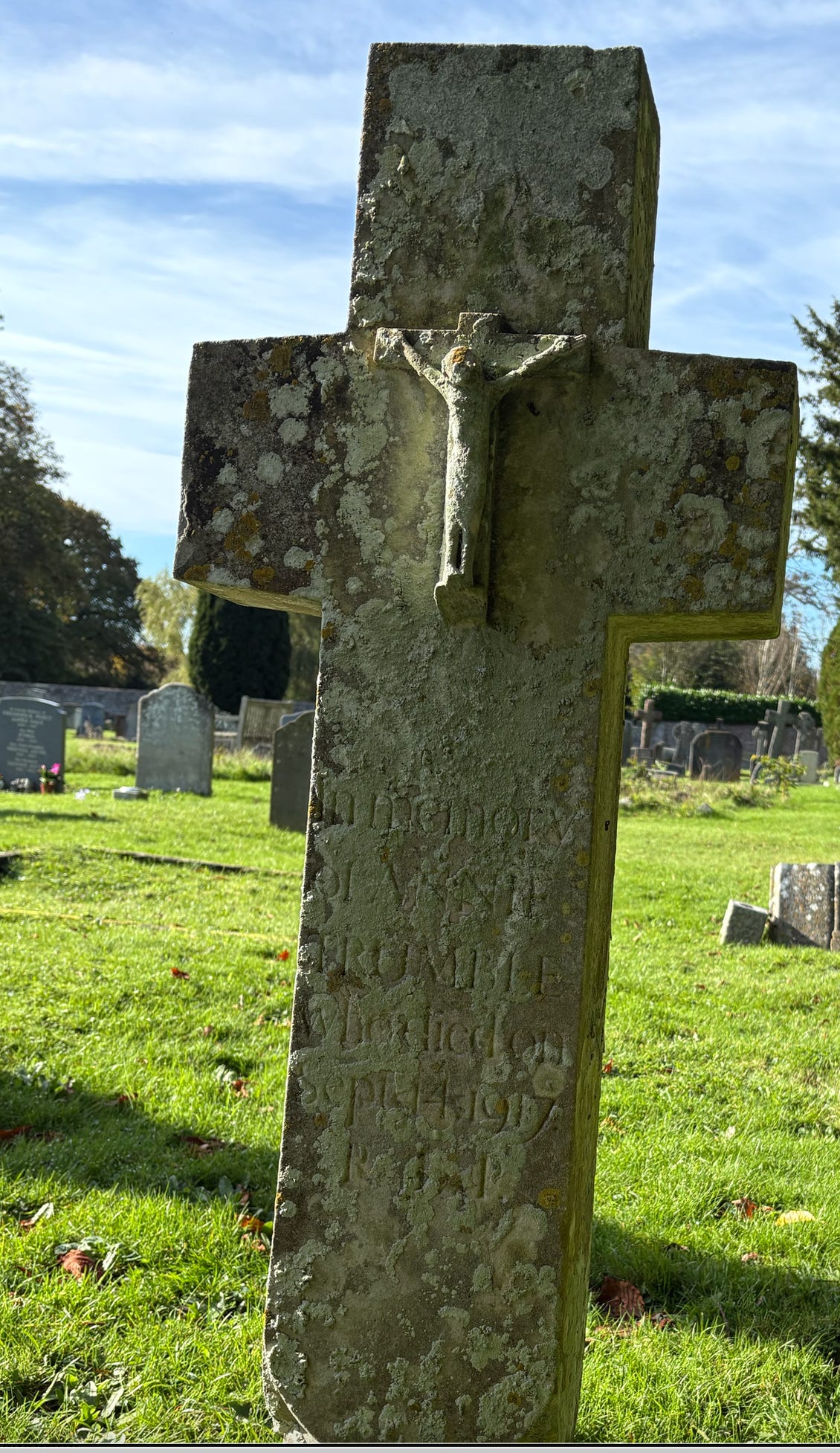
It was rather wonderful. We would arrive at a cemetery, open the book and confirm to each other who we had to find, for example, “Annie Trumble, died in 1917.” Finding the stone sometimes took a while, but luckily most cemeteries weren’t very large. Over time, we got better at it. We developed an eye for Gill’s distinctive style, and sometimes we’d walk straight to the right one.
At the end of our trip, we made a final stop at Brookwood Cemetery, just outside Woking, Surrey. We couldn’t pass up this one as the book said Gill had five gravestones there. We thought it would be a triumphant end to a successful holiday.
We were disappointed. Brookwood is in no way comparable to an old churchyard. It was built in the mid-nineteenth century to provide burial space for the population of a rapidly expanding London. The lion’s share was buried there and that’s quite a few. According to the internet, almost 250,000 people have been buried at Brookwood since 1854.
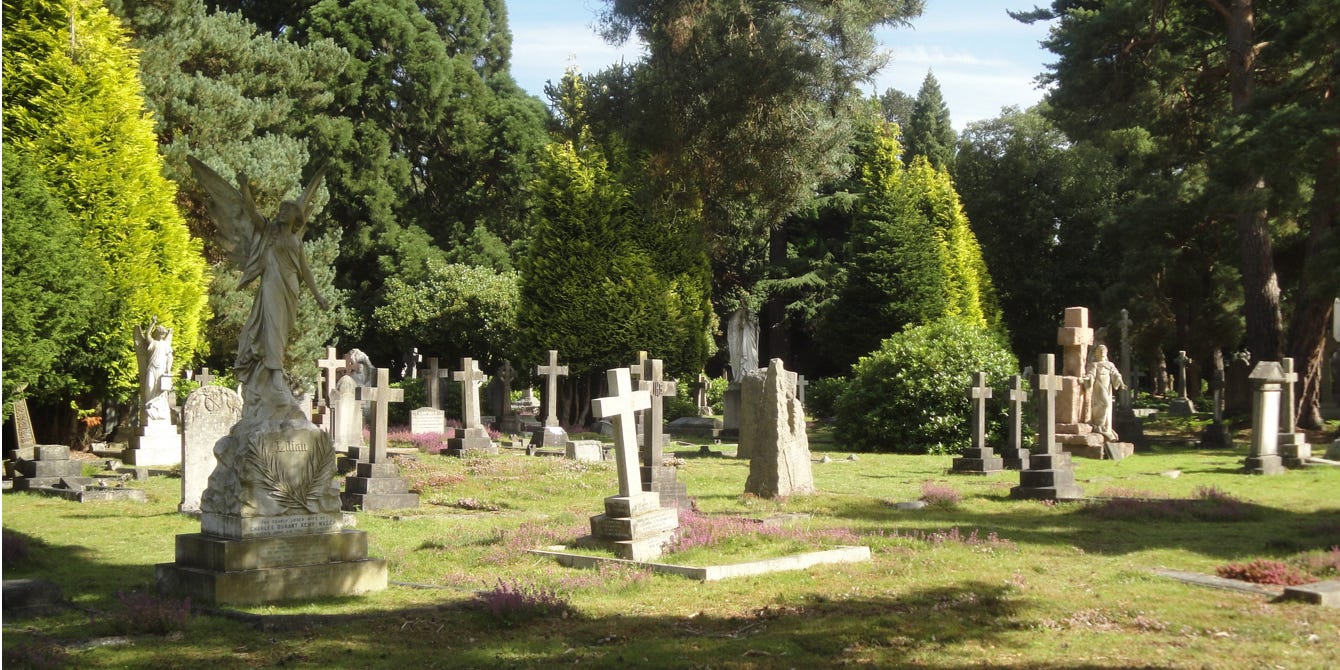
Finding Gill’s gravestones proved impossible. We wandered around for hours, marvelling at the seemingly endless number of graves. Incredibly, parts of the cemetery were largely, sometimes completely, underwater.
A few years ago, on a Sunday morning, we thought it might be good to go back to Brookwood and see if we’d have better luck this time. It was a glorious autumn day, and we wandered around for hours again. Again, without success.
Yet it was another memorable day. The cemetery isn’t as picturesque as the old London cemeteries like Kensal Green and Highbury, but it is peaceful despite it’s intimidating scale. Yet, I still won’t rule out that one day we’ll return to find the gravestone of Ernest Syrett, died in 1906, and his wife Marian, died in 1923.
Lovely!