
Gustav Holst
A Surprise in Chichester

Last weekend I was wandering around Chichester Cathedral and to my surprise, I came across a memorial stone for the composer Gustav Holst. I’d always assumed was Norwegian. It turns out he’s actually English, with Swedish, Lithuanian, and German ancestors, which probably explains my mistake.
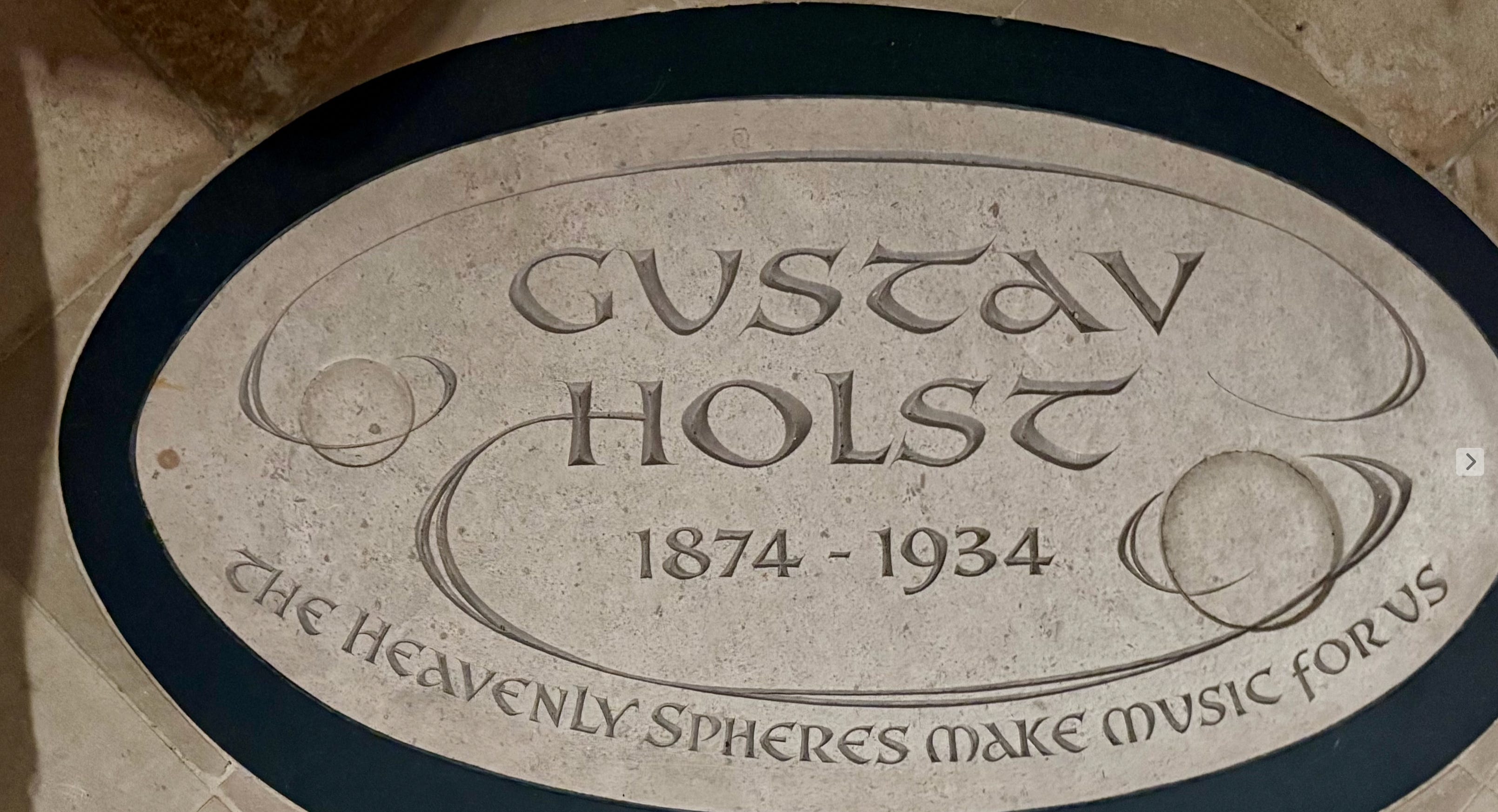
I knew Holst had spent a long time in England. However, I was surprised to read that he was born in England. I probably should have known better. His work “The Planets” is in the top ten of the Classic FM Top 300. The top ten is largely reserved for English composers.
It explains his presence on Classic FM’s chauvinistic Top 300, but it still doesn’t explain why on earth Holst is buried in Chichester. He never lived there, never really worked there, but he did have good friends.
The most important close friend was Geoffrey Bell, the Bishop of Chichester at the time of Holst’s death. Bell was a great lover of contemporary art. As Dean of Canterbury, he had invited Holst to give a concert in “his” cathedral in the late 1920s. Holst was honored by the invitation. He wrote “The Coming of Christ.” It was performed at Whitsun 1928.
In 1929, Bell was appointed Bishop of Winchester. He invited Holst to give a concert around Pentecost 1930. Holst accepted. The cathedral was packed. Holst conducted works by Purcell and Johann Sebastian Bach, among others.
Holst died shortly thereafter on May 25, 1934. He was cremated within a few days. His widow, Isobel, advocated for a burial in Chichester Cathedral, the place where her husband had enjoyed one of the greatest successes of his career. Bishop Bell wholeheartedly agreed.
During the farewell service, conducted by Vaughan Williams (a good friend of Holst and also a permanent fixture in the top ten of the Classic FM Top 300) performed not only music by Vaughan Williams himself but also by Holst.
Initially, Holst was buried on the north side of the cathedral. In 2009, he was moved to the south side of the cathedral, near the spot where the choir he conducted had been so successful a few years earlier.
In 2009, a new stone was installed. That’s the one I saw last weekend. It’s a gem. But it doesn’t quite measure up to the best of Holst’s own oeuvre which has earned him a spot in the Top Ten of All Time. I suspect this is somewhat excessive. He even surpasses the great Bach on the list. Perhaps it’s a good thing Holst didn’t have to see this for himself. It would probably have made him feel deeply ashamed.