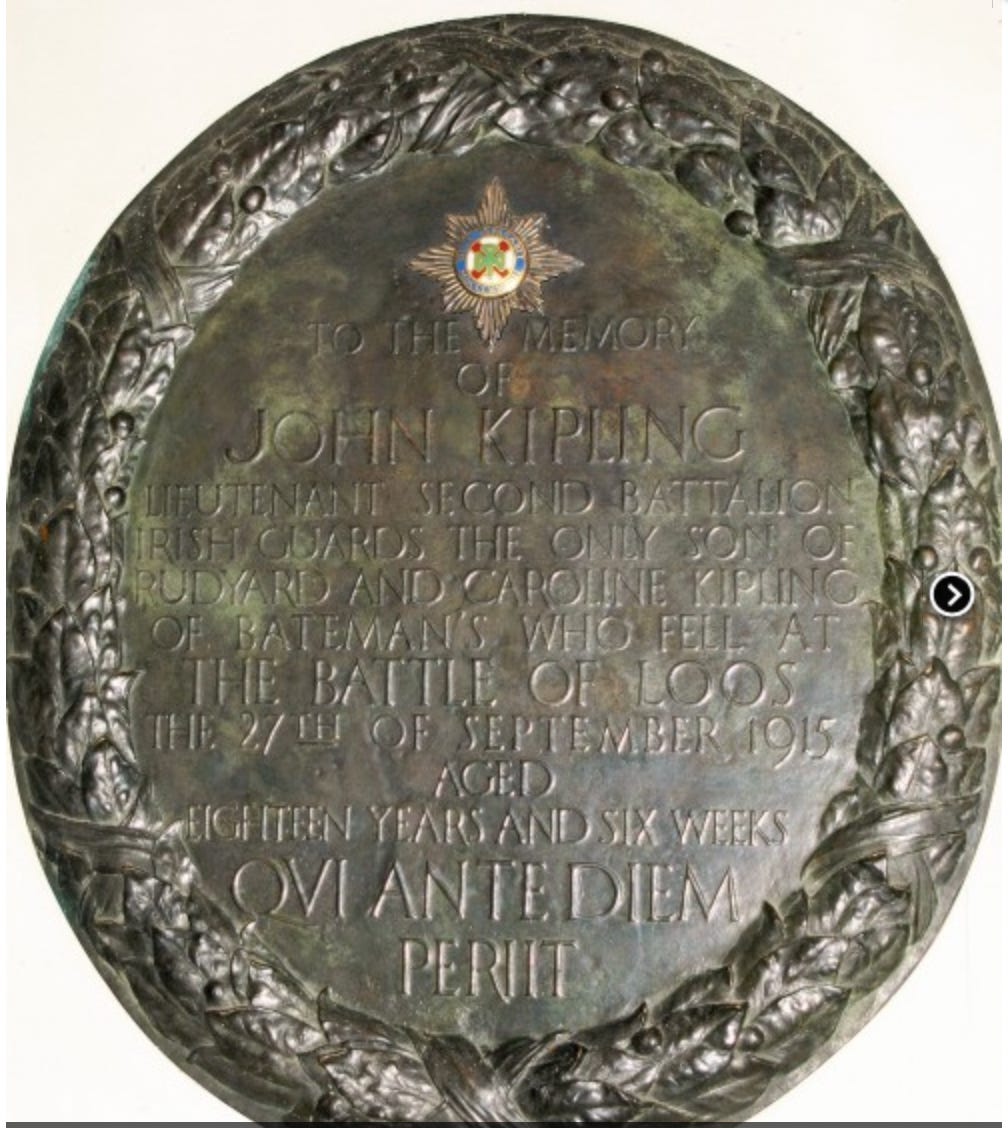
John Kipling
12 november 1915

On this day, Rudyard Kipling wrote a letter to his good friend Lionel Dusterville. It was almost a month and a half since he and his wife Carrie had received the news that their son John was “wounded and missing.” It was the middle of the First World War.
This was the first time Kipling dared to say that his son had died - but he had not quite accepted it. For at least two more years, he continued searching for information about his son, hoping he’d turn up in a German prison camp.
John Kipling was just seventeen when the war broke out. He was nearly blind without his glasses and was rejected for an officer’s commission. Kipling Jr. believed he could still fulfil his patriotic duty as a soldier. Kipling Sr. used his contacts to have his son train as an officer in the Irish Guards. His training began in September 1914. On August 15, 1915, two days before he turned eighteen and could officially be drafted, John was sent to the front.
His first few weeks were mainly spent digging trenches. On September 25th, the Battle of Loos began near Lens in northern France, with British troops attempting to break through the German ranks. Things went wrong. On September 27th, John was declared missing in action. His body was never found. He was not alone. By the end of the First World War, half a million British soldiers were missing.
Kipling never recovered from the loss. The author of The Jungle Book and Kim was the first British writer to win the Nobel Prize for Literature in 1907. After the loss of his son, he hardly wrote anything else, at least not novels. He died a broken man in 1936.
From 1917 onward, Kipling served on the Imperial War Graves Commission. His was a key voice in the decision to provide the same headstone to soldiers and officers. He strongly opposed burying officers (often from wealthy families) back in the United Kingdom, as was customary. “The grief of the mothers and wives of soldiers and officers is the same for all,” Kipling wrote to the House of Commons. He believed both should be commemorated with identical headstones. So it came to be. The size and shape is the same but there is space on the stone for personal details. For example, a Christian cross or the Star of Yahweh can be added, as well as a ephitaph of up to 66 characters, including spaces.
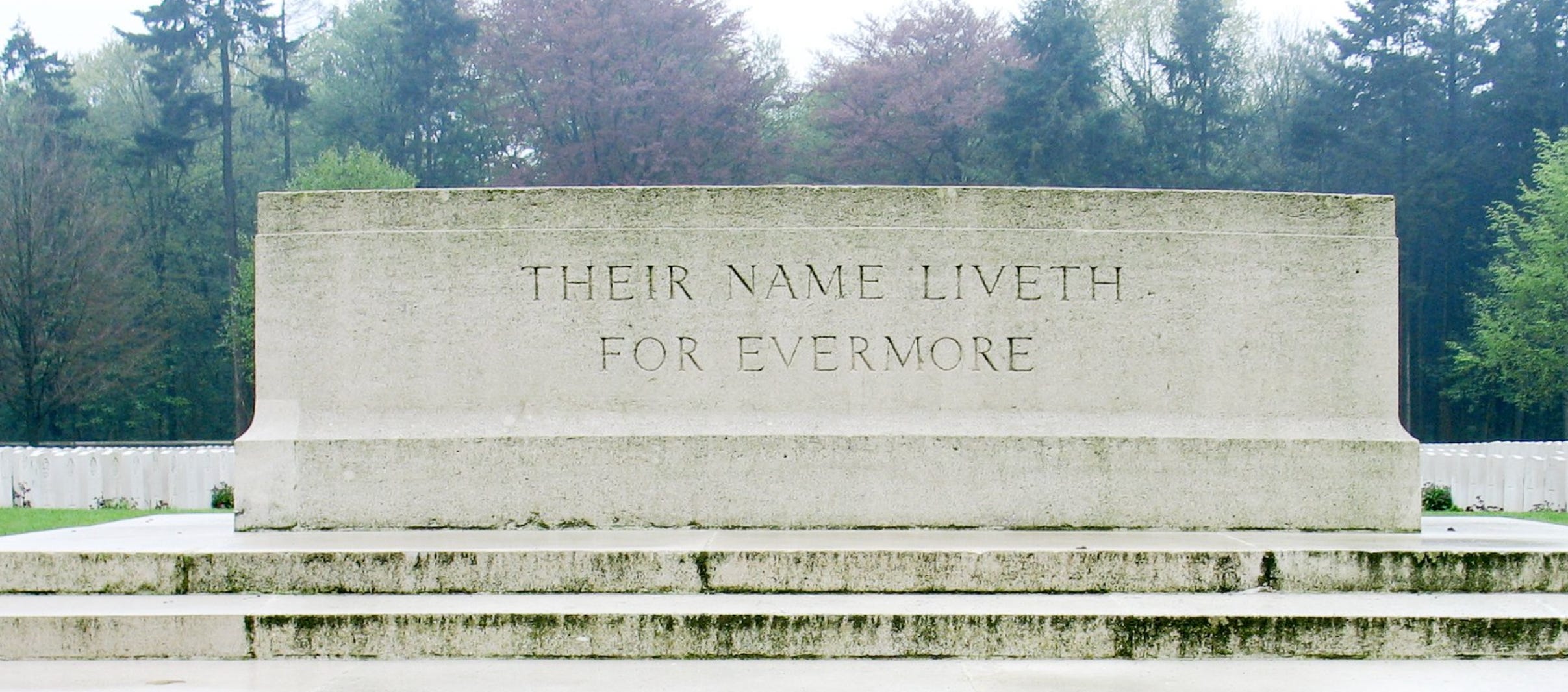
Naturally enough, Kipling also paid special attention to the hundreds of thousands of British servicemen whose bodies were never recovered. Every British military cemetery features a memorial designed by Edwin Lutyens engraved with words suggested by Kipling. The text is taken from the Old Testament, “Their Name Liveth For Evermore.”
When Rudyard Kipling died in 1936, he was convinced his son’s body was lost. However, in 1992, a researcher from the Commonwealth War Graves Commission made a remarkable discovery. In 1919, while searching the war zones, the body of a “Lieutenant of the Irish Guards” was discovered. However, it was found several miles away from the area where the Irish Guards were active.
After extensive research, it was concluded that the body was that of John Kipling. He was the only Irish Guards lieutenant reported missing in this area.
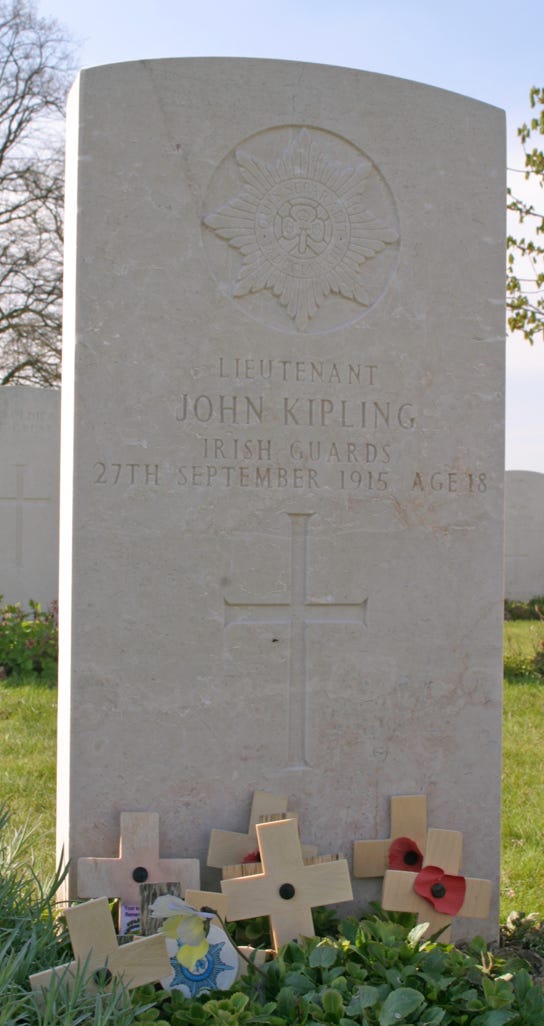
However, there was some controversy surrounding the identification. The soldier in question was a first lieutenant, but John would have been wearing the uniform of a second lieutenant. It is believed that he had been promoted to the rank of First Lieutenant in June 1915, and had updated his uniform insignia accordingly. The confusion arose because his promotion was not officially announced until November, after his death. Ultimately, the unknown lieutenant’s gravestone was re-engraved with John Kipling’s name.
In any case, it’s heartbreaking that Rudyard Kipling, who spent years doing everything possible to locate his son’s body, was unaware of his discovery. It would have made his final years somewhat more bearable.