
Life on Earth
May 8, 1926

On this day, David Attenborough was born. Yes, that was a hundred years ago. It’s an event that no one in the United Kingdom will ignore. The man who shared his wonder at all of earth’s living creatures has become a ‘national treasure’ - but he just smiles to himself about that.
It seems as though Attenborough has spent his entire life doing nothing but expressing his wonder at the wonders of nature, but it was not until 1979, not even half a lifetime ago, that he truly made a name for himself. That was with the series ‘Life on Earth.” Attenborough wrote every line of the script for the thirteen-part series and he also spoke it, with that powerful voice that we now associate with all the wondrous life on Earth.
A special tribute paid by the BBC to its greatest hero follows a timeline of my own life. In 1979, when ‘Life on Earth’ came out, I was thirteen. It was the most accessible and friendly initiation into the secrets of evolution ever. After that, I watched all of the other wonderful series. From The Living Planet (1984), ‘The Private Life of Plants’ (1995) to ‘The Blue Planet’ (2001) and ‘The Green Planet’ (2022), - which explained how (some) plants have sex. They are brilliant.
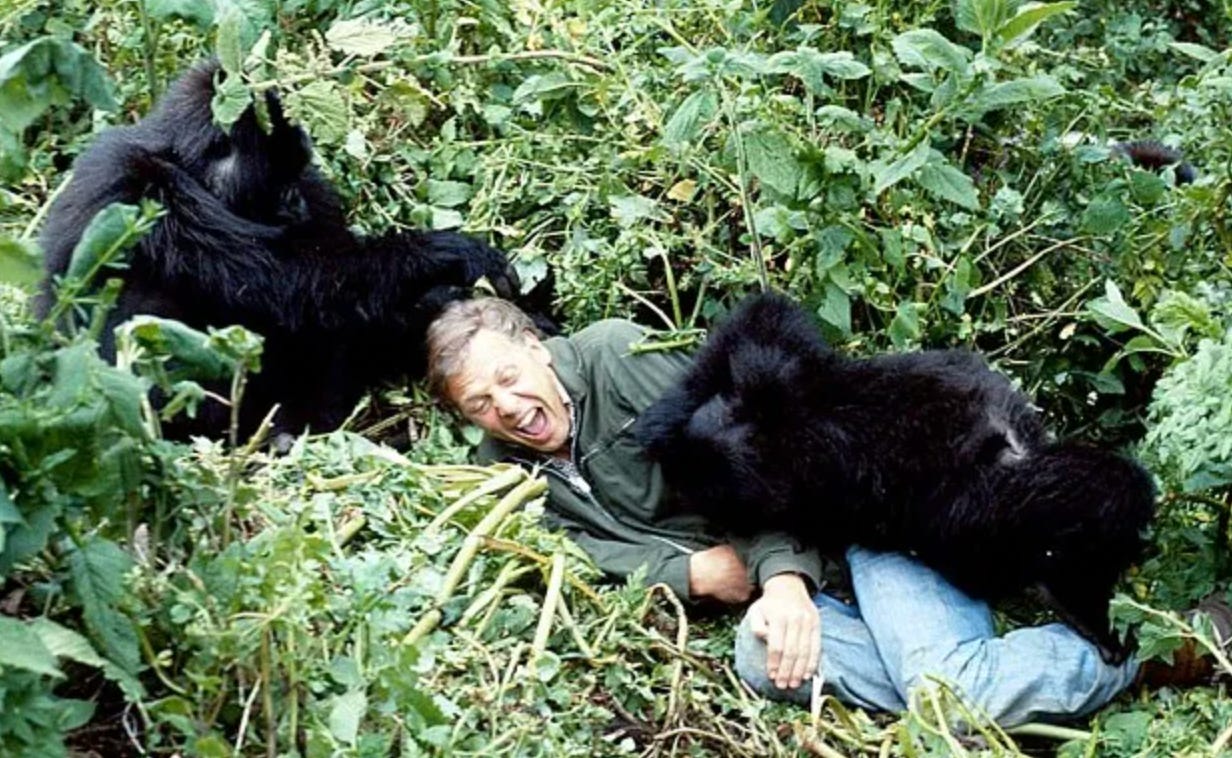
I learned about the kangaroo. When born, it is no bigger than a grain of rice and stone blind, yet with careful feeding, it grows up into the hopping beast loved by everyone (outside Australia). Other footage of Attenborough playing with two young gorillas is hilarious.
And then there’s the snow petrel; the snow petrel that even non-biologists have known about since ‘Life in the Freezer’ (1992). It travels more than three hundred kilometres to forage for food. It was released the year before I moved to the United States where I was surprised to learn that some Americans consider a half-hour drive to a supermarket to be the most normal thing in the world. Clearly descendants of the snow petrel, I would say.
In 1952, Attenborough joined the BBC as a young man. He had a distinguished career, particularly behind the scenes, as his bosses considered his teeth too big for a screen presence. He proved himself excellent at that as well. Among other things, he gave the green light for Monty Python’s Flying Circus.
In the late 1970s, he found his true calling within the BBC as a programme maker and presenter. He was successful in this field. He produced more than a hundred documentaries and series. Attenborough received 32 honorary doctorates. More than one billion people watched the first episodes of Planet Earth (2006).
He remained loyal to the BBC. They paid him handsomely, although the salary he enjoyed as an independent producer never had to be made public. Rumours circulate that he earned four million pounds annually. A pittance compared to the millions the BBC earned by reselling the programs.