
Mass Observation

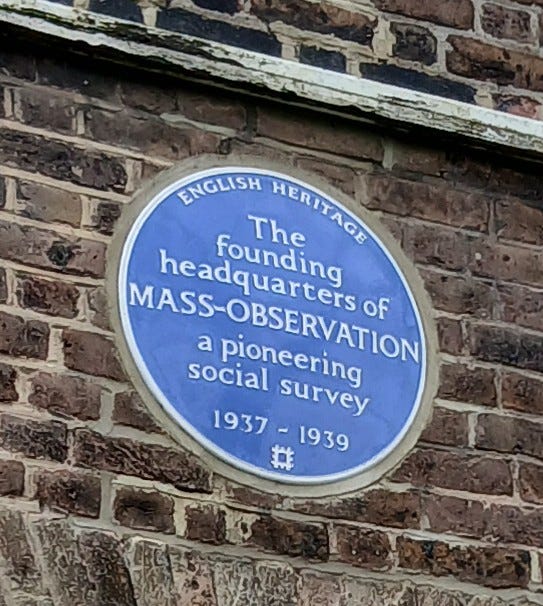
On a back street in Blackheath, an affluent neighbourhood in South London, I recently saw a blue plaque hanging on the wall of a Georgian house. What was striking was that it didn’t bear the name of a person, but of an organisation. The English Heritage plaque offers the passersby of 6 Grotes Buildings the opportunity to reflect on Mass Observation, a British social research project that had its headquarters there between 1937 and 1939.
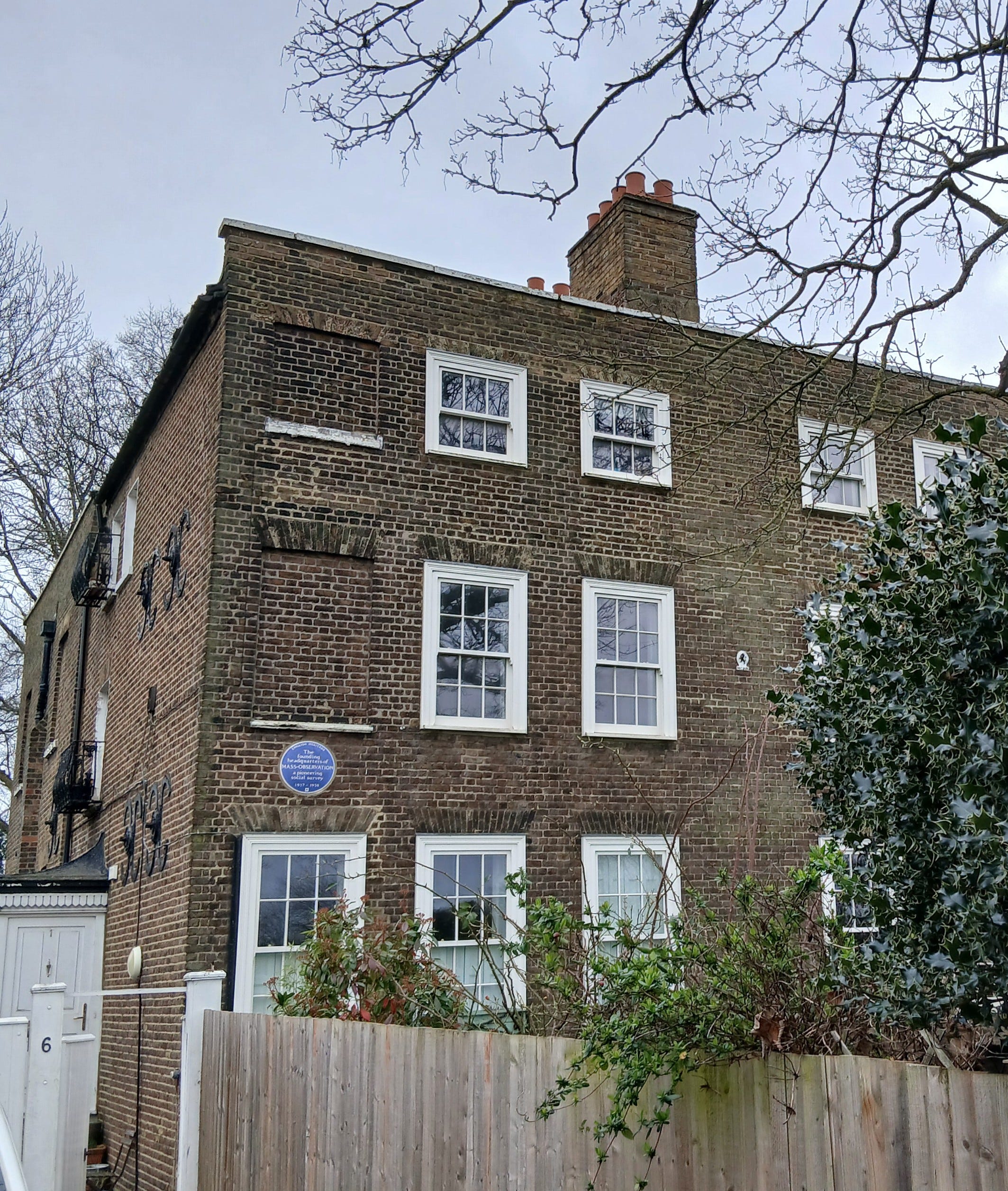
This was the house where co-founder and journalist Charles Madge, along with Tom Harrison, whom he knew from his student days at Cambridge University, discussed the gap between “public opinion” as reported by newspapers and what the British actually thought. This was around the time of Edward VIII’s abdication. In a letter published in the New Statesman, they invited volunteers to keep weekly diaries.
This call resulted in a panel of approximately 500 untrained volunteer observers who kept diaries or completed open-ended questionnaires (known as guidelines). The Mass Observation also paid researchers to anonymously record people’s conversations and behaviour at work, on the street, and at various public venues, including public gatherings, sporting events, and religious gatherings.
The project was supported by the editor of Faber & Faber, T.S. Eliot. At the end of the first year, the Mass Observation Day Survey was published—a report on public reactions to the coronation of George VI. It also examined attitudes toward the government’s appeasement of Hitler and found that 40 percent of respondents admitted to not understanding foreign policy at all.
Women were well represented and played an important role within the organisation: Austrian sociologist Gertrude Wagner initiated research into shopping habits in Bolton (partly by following people in Woolworths). Her partner, Bill Naughton, a coal merchant, was also among the workers recruited by the organisation. The headquarters moved to Notting Hill shortly before the war.
It wasn’t uncontroversial. Why, some wondered, does a group of immature know-it-alls feel justified in spying on their fellow countrymen? Some journalists described it as “an unparalleled opportunity for the nitpicky, the malicious, the grumpy, the meddlesome, and the slightly eccentric.” One researcher was nearly beaten up in a pub for trying to take a photo.
The pub was an important place. Research found that the average time to drink half a pint of beer in Brighton pubs on a Saturday night in November 1938 was 7.3 minutes. The study in pubs in Bolton, Blackpool, and Brighton in 1938 found that people drank their pints slowest on Tuesday nights and fastest on Friday nights. Mass Observers also collected data on the number of cigarettes smoked per pint.
The Second World War effectively ended the project in August 1940, but it did lead to commissions from the Ministry of Information, where George Orwell worked, to survey public opinion about the bombings and thus contribute to policymaking. In time, Charles Madge became uneasy about the organisation’s transformation into a “listening machine for the government” and resigned.
The organisation is probably best known for its work during the war, but it continued for decades afterward. It’s findings were a goldmine for sociologists and historians. Authors like David Kynaston eagerly tapped into it for the books he wrote about Britain in the decades after the war. Behavioural observation ceased in the mid-1960s, but was revived, temporarily, in 1981.
Today, there is social media, as well as the highest density of security cameras in the western world…
 | A guest post by
|