
The perfect marriage
George Eliot and prevailing morality

Marian Evans was thirty-three when she thought the best part of her life was behind her. She felt a bit like a caterpillar, appreciated for her intelligence, but simply not attractive enough to bind men to her. In 1853, she met Henry Lewis and the caterpillar transformed into a butterfly. We now know her by the pen name she adopted that year: George Eliot.
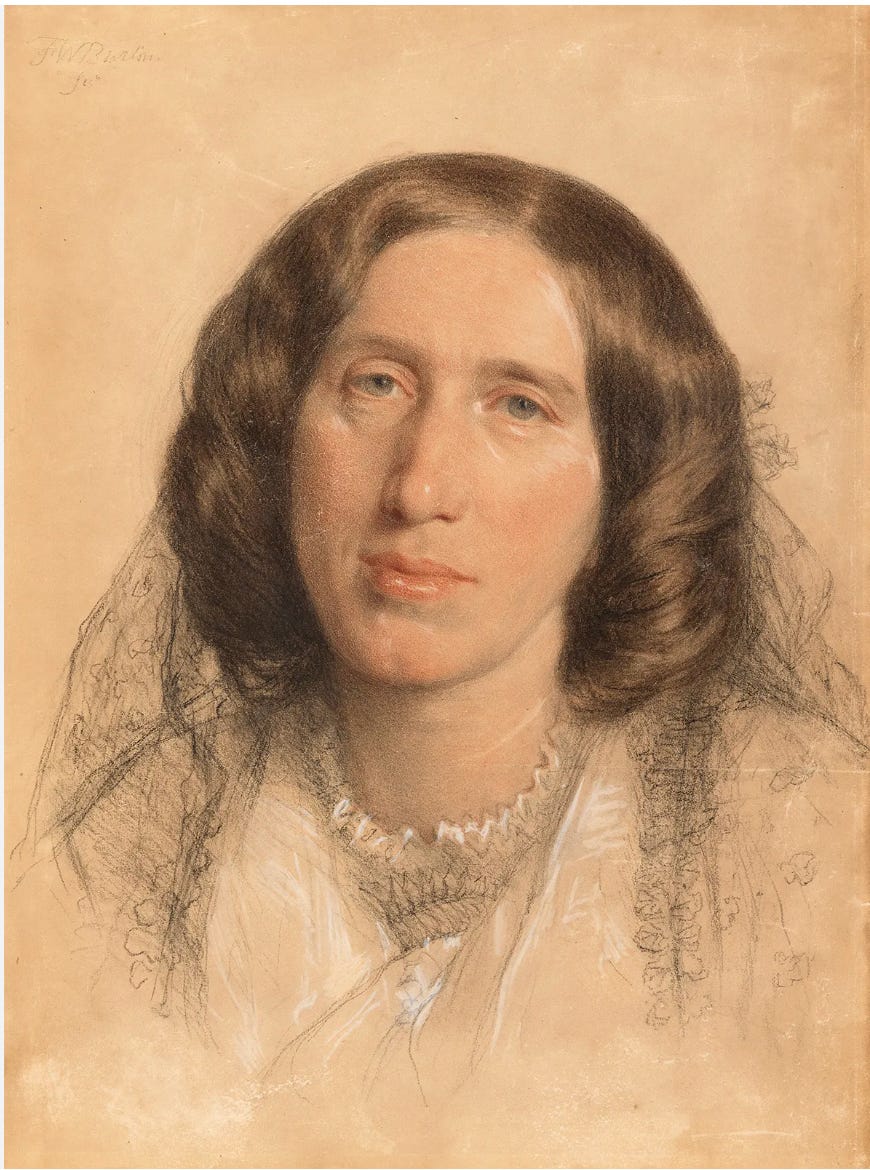
The ‘best part’ of Mary Evans’s life was not all that excellent. At the time, she lived in London in a house with John Chapman, the publisher of The Westminster Review, which Evans edited almost single-handedly. Chapman’s wife and mistress also lived in the house. They kept a watchful eye on any potential romantic attachment between Evans and Chapman.
Henry Lewis was married when he met Mary Evans. He had, as Phyllis Rose describes in her excellent *Parallel Lives *, ‘something that we would nowadays call an open marriage’. His wife’s relationship with a writer friend was viewed by Lewes as a temporary ‘whim’. He accepted the children his wife had from her adultery as his own.
Gradually, however, Lewes realised that it was not an ‘open’ marriage, but ‘no’ marriage. Around the same time, he met Mary Evans. They soon moved in together. According to Rose, it was ‘the perfect marriage,’ with the understanding that they would never marry each other.
Soon after they first met, Lewes was sent to England for health reasons. Evans went with him. They enjoyed each other’s company. In the evenings, they read books aloud to each other for hours. They began with something entertaining, then moved on to something educational, and before going to sleep, would read a series of poems, preferably by Heinrich Heine.
At one point, Evans read an excerpt from a novel she’d begun writing several years ago. Lewes was positive, but suggested that a novel is not only about humour, but also about drama. Some days later, Evans read aloud her description of the death of the protagonist’s wife. With tears in his eyes, he gave her a kiss. “Your drama is even better than your humour.”
Over the next thirty years, Evans wrote novel after novel under the pseudonym George Eliot. She was, by her own account, aided by the fact that she was ignored by most of her friends and relatives because of her extramarital affair with Lewes. Victorian morality dictated that her ‘husband’ was invited to dinners and social occasions, but Evans was not. ‘The lack of respectability from her relationship means that Evans does not have to bear the burden of upholding this respectability,’ as Rose describes it.
Adam Bede, Mill on the Floss, and Middlemarch became bestsellers. Eliot became the most celebrated female writer of her time. However, when she died in 1880, she couldn’t be buried in Westminster Abbey, as was her wish. Incidentally, this was not only to do with her unorthodox relationship; she had also turned against religious dogma at a young age. That was not acceptable to the royal church.
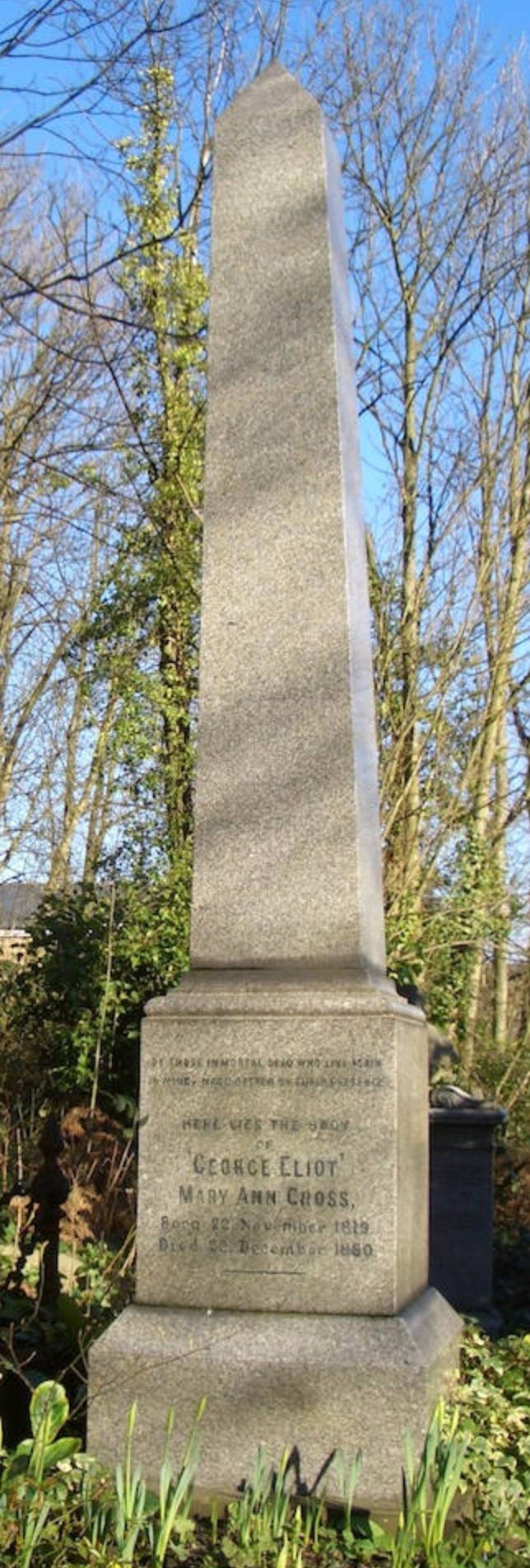
George Eliot is buried in Highgate Cemetery, not far from Karl Marx, under the name Mary Ann Cross. She married John Cross, her financial advisor, the year before her death. George Lewes had died in 1878. After a year of ostentatious mourning, Evans decided it was time for a new chapter in her life. Although this time she was properly married, the Victorian establishment once again reacted with shock. Cross was more than twenty years younger.
According to Phyllis Rose, this new societal outrage brought George Eliot great pleasure. The second part of her life had undoubtedly been the best, Rose suggests.