
Train Tickets

As a child, I collected train tickets. After school, I’d go to the platforms at Den Dolder station to politely ask disembarking passengers if they’d mind handing over their tickets. On vacation, I could often be found at stations, from Wylre to Warffum. I had a nice collection of brown cardboard tickets. These days, tickets are a rarity in the Netherlands. A modern collection would consist solely of one-way trips between Schiphol Airport and Amsterdam.
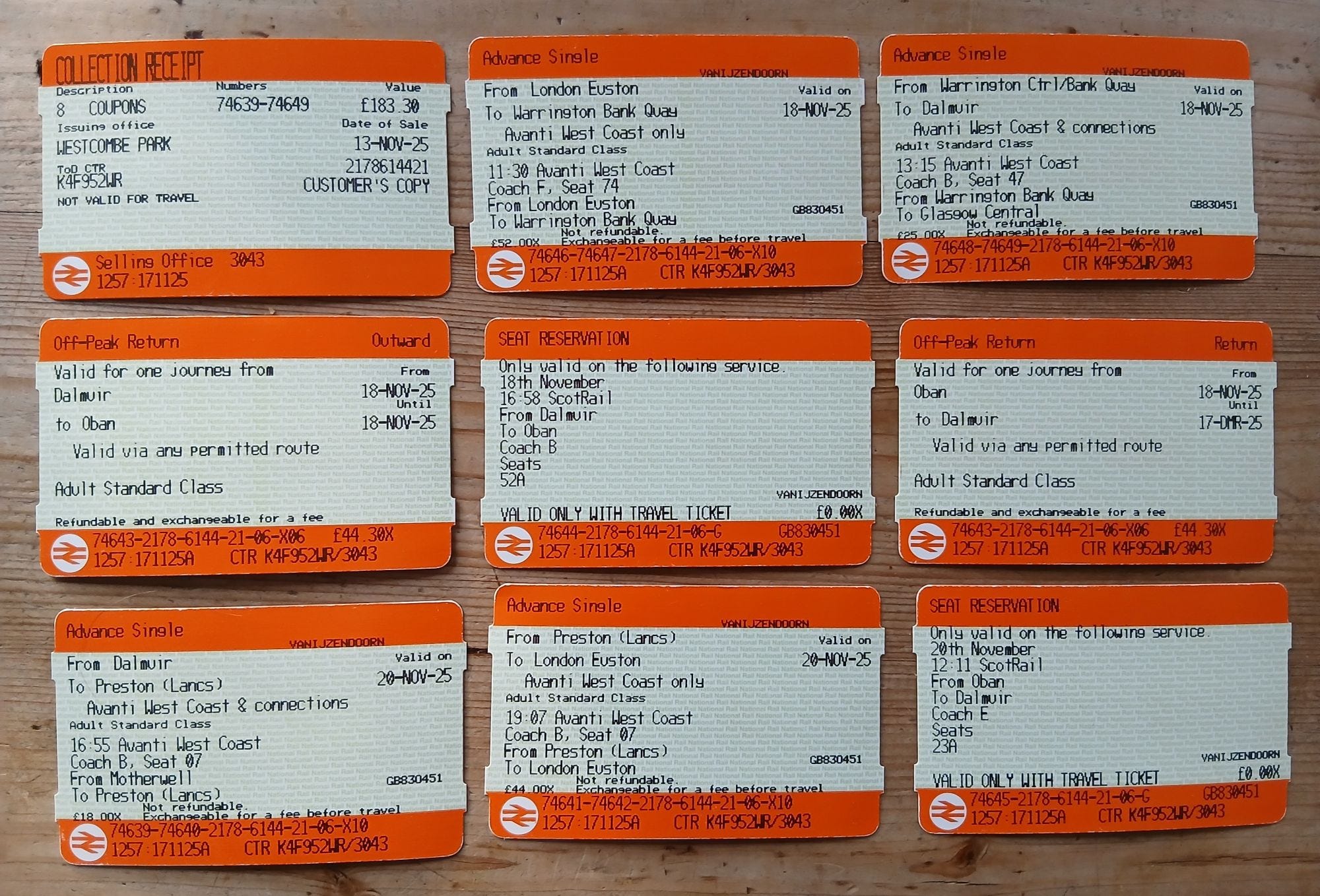
In the UK, where progress is occasionally delayed, I could easily pick up this hobby again. In fact, there’s a way to speed up the process of building my collection: buy tickets on the website Splitmyfare. Splitting a journey into multiple legs is often cheaper, resulting in a stack of tickets, plus seat reservations. I received nine tickets between London and Oban. My photographer, who traveled from Hastings, had four more.
The website offers an electronic ticket option, but I prefer to have them printed out at a ticket machine. Not because I save them, although I still have the urge forty years later, but because there’s a good chance I’ll need them to claim a refund in case of a delay. If there’s one thing British railways excel at, it’s “Delay Repay.” Passengers are entitled to compensation after a fifteen-minute delay. The longer the delay, the higher the compensation. After more than three hours, it’s 100 percent.
When applying, you need to take a photo of your tickets and provide a five-digit number. It’s difficult to find the information because each train company assigns tickets slightly differently. The compensation is usually transferred within a few days. Over the years, I’ve received hundreds of pounds. Trains from London to Manchester, Liverpool, and Glasgow are especially vulnerable to strikes, ice, signal failures, “people on the tracks,” staff shortages, and landslides.
On football days, trains are often overcrowded, making it impossible to reserve a seat. The hope then lies in finding a spot in the unreserved compartments. The trick then is to know which platform a train departs from. In Germany or the Netherlands, this is known six months in advance, but at London’s terminal stations, it’s only fifteen minutes. Savvy train travellers surf to Realtime Trains, a train spotting website. The correct platform is already listed there hours in advance. This saves a final sprint to the train.
A nuisance on the British railways, which celebrated its 200th anniversary earlier this year, are the countless public address announcements that are unavoidable even in the quiet carriage. The “See it. Say it. Sorted” announcement, intended to report unusual events to the transport police, has been dubbed by The Times as the most irritating slogan in the country’s transport history. On some lines, it plays after every stop. A particularly thoughtful announcement urging passengers to claim compensation after a delayed journey is also noteworthy.
The journey itself is often pleasant on British trains. Fellow passengers are generally friendly and the seats comfortable, especially those on Great Western trains. It’s convenient that bicycles can be taken along free of charge, which comes with four extra tickets: two to show the conductor and two to hang on the handlebars. Conductors are very trusting. Anyone without a ticket is given the opportunity to buy one, usually at no extra cost. Sometimes a conductor has an old-fashioned ticket swipe, which makes my young heart beat faster.
 | A guest post by
|